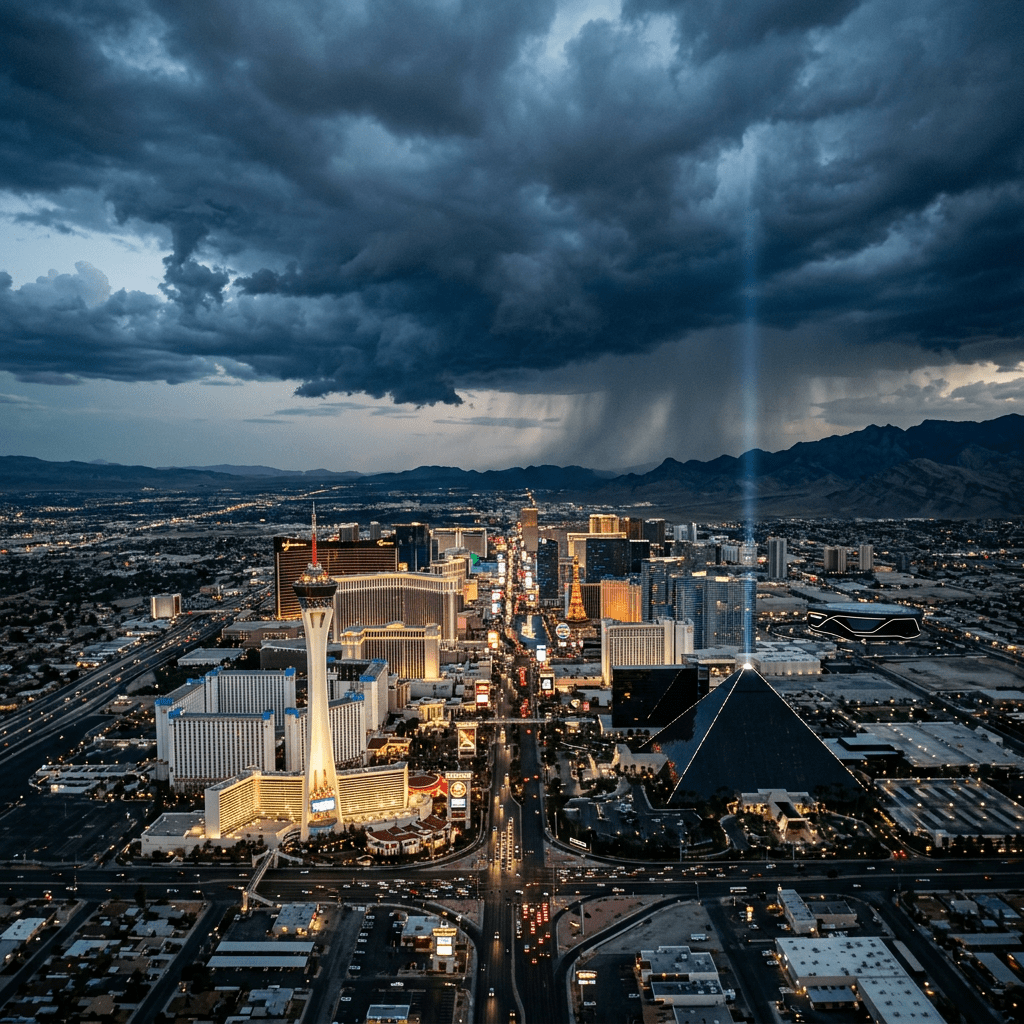
A two-week stretch that reshaped Las Vegas
For most of the past two to three years, the casino sector talked about consolidation far more than it executed it. The 2024 rumor mill was active but produced no large-scale operator deals — speculation that Boyd Gaming might acquire Penn Entertainment, for example, never advanced past chatter, and as late as October 2025, Stifel analysts were reporting that M&A talk at the Global Gaming Expo was subdued, with Strip appetite “limited until interest rates come in further.”
That caution evaporated in the spring of 2026. Within a single week at the end of May, the two largest casino operators on the Las Vegas Strip both became acquisition targets. The pattern that finally broke the logjam was the one analysts had predicted: lower financing costs and a more permissive regulatory posture under a new FTC, combined with a persistent gap between public-market valuations and the perceived value of irreplaceable real-world assets.
The backdrop: why M&A interest has been building
The structural drivers behind the recent wave were in place well before the deals landed. After a challenging 2024 — in which many operators’ equities fell out of favor — the 2025 outlook turned more constructive, supported by interest-rate cuts and expectations of a friendlier antitrust environment. Truist’s year-end summit flagged 2025 as a likely inflection point for gaming M&A, citing declining financing costs and changes at the FTC as the key catalysts.
Activity below the marquee-operator level had already picked up. The technology and supplier layer of the industry saw meaningful consolidation: Apollo Global Management completed its roughly €5.42 billion acquisition of International Game Technology’s gaming and digital division alongside Everi, creating one of the largest privately held gaming-technology groups in the world, and Evolution absorbed Las Vegas table-game supplier Galaxy Gaming. The broader gaming-and-esports market recorded $27.3 billion in disclosed deal value across more than 960 transactions in 2024, a 39% jump over the prior year, with private equity increasingly willing to take listed gaming companies private to exploit the valuation discount.
What was missing was a large-scale operator transaction. By mid-2026, two arrived almost simultaneously.
Caesars: the first domino
On May 28, 2026, Tilman Fertitta’s Houston-based Fertitta Entertainment announced a definitive agreement to acquire Caesars Entertainment in an all-cash transaction valued at roughly $17.6 billion, including the assumption of approximately $11.9 billion of Caesars debt. Caesars shareholders are to receive $31.00 per share — a 49% premium over the unaffected share price before takeover rumors surfaced in late February, and a 46% premium over the 30-day volume-weighted average price.
If completed, it would stand as the largest casino acquisition in U.S. history. Fertitta — already owner of the Golden Nugget casinos, the Landry’s restaurant empire, and the NBA’s Houston Rockets — would fold Caesars’ eight Strip properties and its broader portfolio into a vertically integrated leisure conglomerate of roughly 60 resorts worldwide, anchored by the Caesars Rewards loyalty network. Notably, Fertitta outbid Carl Icahn, whose Icahn Enterprises had submitted a competing offer around $33 per share. The Caesars board unanimously approved the deal and recommended it to shareholders, while preserving a “go-shop” period running through approximately July 11, 2026, during which Caesars may solicit alternative bids. Morgan Stanley and Goldman Sachs advised Fertitta; PJT Partners advised Caesars.
MGM: the bigger prize and a familiar suitor
Less than a week later, on June 1, 2026, the second domino fell — and the buyer was the company that had been quietly positioned for nearly six years.
People Incorporated — the holding company formerly known as IAC — submitted a non-binding proposal to acquire all of MGM Resorts International shares it does not already own for $48.30 per share in cash, valuing MGM at roughly $18 billion. People Inc. already holds about 26.1% of MGM; the offer covers the remaining ~74%, representing roughly $12.4 billion in equity value before debt. The price carries a 10.6% premium over MGM’s closing price on May 29 and a 24.1% premium over the stock’s 30-day volume-weighted average. Under the proposed structure, People Inc. would hold just over 50.1% of MGM and control the company, taking it private, with other investors retaining non-controlling minority stakes. Financing would combine cash on hand at both People Inc. and MGM with additional debt and equity, and Barry Diller noted the company had already held preliminary conversations with potential equity investors and financing sources.
MGM confirmed receipt of the offer and said its board, with financial and legal advisors, would review it in the interest of all shareholders, adding the standard caveat that no transaction is assured.
The strategic rationale: a thread running back to 2020
The MGM proposal is the culmination of a thesis IAC first articulated in August 2020, when it accumulated a roughly 12% stake — about $1 billion — in MGM. At the time, the rationale was explicitly digital. Barry Diller and then-CEO Joey Levin framed it as a classic IAC play: own a meaningful piece of a preeminent brand in a large category with “immense potential to move online.” What drew them was not primarily the casinos or hospitality but the sliver of revenue that “rounds down to zero” — MGM’s online gaming business, principally its BetMGM joint venture. IAC’s stated foundational concept was building interactive businesses, and it saw a “digital first opportunity” inside MGM’s substantial offline operations, in a global online-gaming industry it pegged at roughly $450 billion with less than 10% U.S. penetration. Diller and Levin joined MGM’s board, where they still sit.
Six years on, the framing has evolved in a revealing way. In his June 2026 letter to MGM’s board, Diller argued that the original conviction “has only strengthened over time,” but the emphasis has shifted from a pure digital bet to something more defensive and asset-driven. He described MGM as “a rare kind of business” — one with real-world assets that artificial intelligence “cannot easily replicate or disintermediate,” paired with digital businesses positioned for long-term growth. In other words, the case is now partly that MGM’s nearly 40% of the Las Vegas Strip is an “entertainment nucleus” and a durable, AI-resistant store of value, while BetMGM supplies the growth optionality. Diller’s core complaint — that the public market “materially undervalues the power and durability of MGM’s assets” — is the same valuation-gap argument IAC made in 2020, now used to justify taking the whole company private rather than holding a minority stake.
The digital piece remains material to the thesis. BetMGM, co-owned with Entain, grew net revenue meaningfully in 2025 — analysts at Macquarie pegged it as a digital growth leader that year at around 30%, ahead of larger rivals FanDuel and DraftKings on a growth basis even as it sits a distant third in market share — and projects adjusted EBITDA of roughly $300–350 million for 2026, targeting about $500 million by 2027. The upside case leans heavily on the potential proliferation of legal online casino (iGaming), which would make that growth “potentially exponential.”
Who are the likely buyers of Las Vegas casino assets?
The two 2026 proposals are instructive about where the buying power for large Strip assets now sits. Three broad categories of buyer stand out.
First, private operator-conglomerates run by individual billionaires. Fertitta is the archetype: a privately controlled hospitality empire able to finance an all-cash, debt-heavy take-private and willing to absorb a large existing debt load. This model favors buyers who already understand integrated leisure economics and can fold casinos into restaurants, loyalty programs, and entertainment.
Second, strategic holders converting minority stakes into control. People Inc. is the clearest example — a patient investor that built a base position, took board seats, and waited years for the right moment to bid for the whole. This path is available to relatively few players but is powerful when the holder already knows the asset intimately.
Third, activist and opportunistic financial buyers. Carl Icahn’s competing bid for Caesars shows that activist investors remain circling, and private equity has been the most consistently cited source of take-private demand across the sector, deploying record dry powder against discounted public valuations. Apollo’s IGT/Everi combination demonstrates that PE appetite is real, though it has so far concentrated more on the technology and supplier layer than on owning Strip real estate outright.
Several factors will determine how far this wave runs. Strip assets carry large average purchase prices, so appetite remains sensitive to interest rates; the deals that broke through did so partly because financing conditions and the regulatory climate improved. Competitive pressure in online sports betting, softening Las Vegas tourism, and the emerging threat of prediction markets are real headwinds — but analysts have generally characterized them as surmountable, and Macquarie maintained an outperform view on MGM even before the People Inc. bid.
What to watch next
Both transactions are proposals, not closings. Caesars’ go-shop window through mid-July leaves room for a rival to top Fertitta, and MGM’s board has only acknowledged receipt of the People Inc. offer — it has neither endorsed nor rejected it, and a non-binding bid at a roughly 10% premium to the recent close may draw pushback on price. Regulatory approval, gaming-license review across multiple jurisdictions, and shareholder votes all lie ahead.
What is already clear is that the long-anticipated consolidation of the Las Vegas Strip has finally moved from rumor to term sheet. If both deals close, control of the two largest Strip operators will pass into private hands within months — Caesars into Fertitta’s leisure conglomerate, and MGM into the hands of the digital-media holding company that has been patiently building toward exactly this outcome since 2020.


Leave a Reply