Kash
What It Is, Backers & What Would Have To Be True
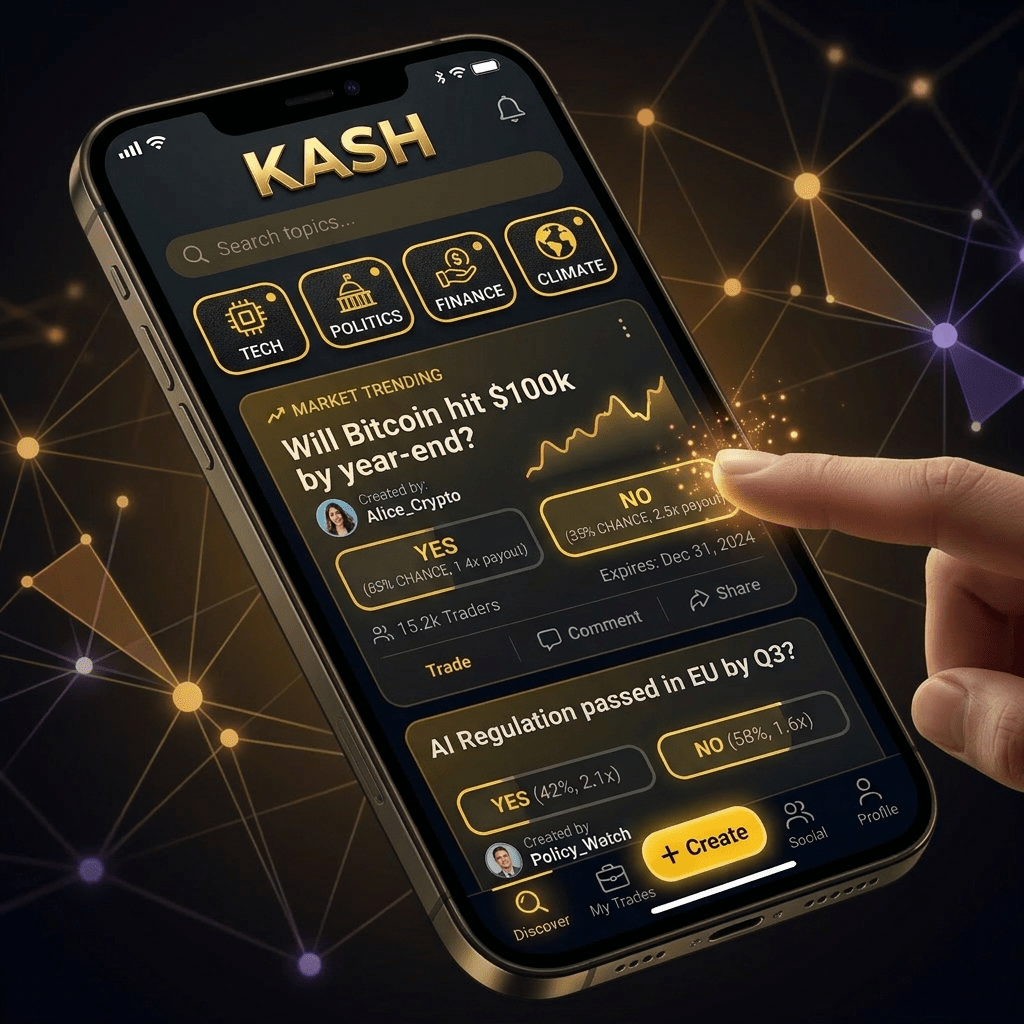
Kash is a social-native, permissionless prediction-market protocol that lives inside the X feed rather than in a standalone app. By quote-posting with @kash_bot, users create or trade markets on real-world events (elections, macro, sports, culture) without leaving the platform; settlement is on-chain (Base), self-custodial, and resolution is handled by an AI + zero-knowledge “trustless oracle.” The thesis, per its backers, is that prediction markets’ missing piece has always been distribution — and Kash puts them where the opinions already flow.
What Would Have To Be True (to ENGAGE)
- ▮A regulatory survival path: a credible answer for how permissionless, leveraged betting on sports/elections via a social bot avoids being unregistered/unlicensed gambling and event-contract/securities violations — the CFTC-regulated venues (Kalshi) sit on the opposite side of this line.
- ▮Harm-aware redesign: the 15-minute flash markets + leverage + gamification + viral referral combination is a textbook high-velocity gambling accelerant; loss limits, KYC/age-gating and removal of the most addictive mechanics would have to come.
- ▮Platform independence: proof the distribution survives if X restricts or bans the bot — today the entire GTM rests on a third party Kash does not control.
- ▮Oracle reliability: evidence the AI/ZK resolution mechanism is manipulation-resistant and dispute-proof across permissionless, ambiguous markets.
Assessment: the best-articulated of the crypto-native prediction-market screens — real founder, real backers, a genuinely clever distribution wedge. But the product, as designed, is permissionless leveraged gambling optimised for virality and velocity, on a borrowed platform, outside the regulated path. The team is investable; the current product is not.
Weighted Screen, Legend & Action Band
Weighted against the six-criterion rubric. Cells left-aligned; ball + label; risk-resolved inverted (higher = fewer unresolved risks). Low scores reserved for affirmative observable problems — here, platform-dependency and the high-harm/anti-regulated design.
| Criterion | Weight | Rating | Rationale |
|---|---|---|---|
| Differentiation / product | 20% | ◕ STRONG (3) | Sharp and distinctive: prediction markets as a social-media-native primitive (in-feed via @kash_bot, “no interface”), permissionless creation, flash markets, leverage via custom bonding-curve AMM, AI+ZK oracle. The distribution wedge is the real insight. |
| Sector fit | 20% | ◑ MODERATE (2) | On the prediction-market mega-theme, but a permissionless, leveraged, crypto-native gambling protocol — off the regulated/B2B lane the fund favours, with a harm profile awkward for a value/growth mandate. |
| Traction / validation | 16% | ◑ MODERATE (2) | Credible $2m pre-seed from a broad crypto syndicate (Coinbase Ventures, Animoca, Spartan) + early live product on X. Investor validation; market traction unproven (pre-broad-launch). |
| Founder / team | 12% | ◕ STRONG (3) | Named, domain-relevant founder — blockchain security + AI + HFT, govt/tier-one-bank background. Exactly the profile for a trustless-oracle markets protocol; a genuine strength and the key differentiator vs Rocket. |
| Moat | 16% | ◔ WEAK (1) | Affirmative fragility: the distribution depends on X (a platform Kash does not control and which could restrict gambling bots); crypto protocols are forkable; permissionless = no curation moat; Polymarket/Kalshi/other social-PM entrants could replicate. |
| Risk resolved (inverted) | 16% | ○ UNFIT (0) | Maximal unresolved risk: permissionless + leverage + 15-minute flash markets + gamification + viral referral + self-custodial crypto + an explicitly anti-regulated posture + total X-platform dependency + an unproven AI/ZK resolution oracle. A high-harm, high-regulatory-exposure design. |
| WEIGHTED FIT SCORE | 100% | 1.84 / 4.0 | Action band → MONITOR (low) |
MONITOR — 1.84 / 4.0, low end. A Strong founder and Strong product-differentiation are dragged down by a Weak (platform-dependent, forkable) moat and an Unfit risk-resolved score. The Founder score is the only reason this clears the PASS line that Rocket did not — the risk profile is otherwise the same.
Competitors & Stress-Test
Kash competes on two fronts: the prediction-market field (regulated and crypto), and the emerging crypto-native gamified-PM cohort.
| Player | Model | Posture | Read vs Kash |
|---|---|---|---|
| Kash | social-embedded permissionless PM (X, Base) | crypto, anti-regulated | best distribution wedge, severe risk |
| Kalshi | CFTC-regulated event contracts | regulated | the compliant benchmark Kash is not (~$11–22bn) |
| Polymarket | crypto event contracts | semi-regulated (QCEX) | giant; ICE-backed; could add social |
| Rocket | continuous “redistribution markets” (MegaETH) | crypto | peer crypto-PM; screened PASS 1.72 |
| FEEN | 30-sec token-race gamified PM | crypto | closest analogue; screened MONITOR |
Risk & Moat Stress-Test
- ▮Platform dependency (the distinctive risk). Kash’s entire distribution edge rests on @kash_bot living in X. X can restrict or ban gambling/financial bots at will — the moat is borrowed, not owned. This is an affirmative, single-point-of-failure fragility.
- ▮Regulatory. Permissionless, leveraged betting on sports/elections via a social bot is, on its face, unregistered/unlicensed gambling and possible event-contract/securities activity — the opposite of Kalshi’s CFTC path. Decentralisation routes around, not through, regulation.
- ▮Consumer harm. 15-minute flash markets + leverage + leaderboards/multipliers + viral referral + frictionless in-feed access is a high-velocity, gamified gambling design — among the most harm-maximising configurations screened. An ESG/regulatory-crackdown liability.
- ▮Oracle & integrity. An AI/ZK “trustless oracle” resolving arbitrary, permissionless markets is novel and unproven — manipulation, ambiguity and dispute risk; permissionless creation invites harmful/illegal markets with no gatekeeping.
- ▮Forkability. Crypto-native, open infrastructure; the mechanism is copyable, and incumbents (Polymarket) have the resources to bolt social distribution on.
Known vs Unknown
Observable vs diligence-dependent (absence of data = diligence item, not a mark against).
| Known (observable) | Unknown (diligence) |
|---|---|
| $2m pre-seed; broad named syndicate (Coinbase Ventures, Animoca, Spartan, Fabric) | Valuation, terms, token plans, runway |
| Founder Lucas Martin Calderon; security+AI+HFT background | Team depth beyond founder; governance |
| Product live on X via @kash_bot; on-chain on Base | Active users, volumes, retention, real traction |
| Permissionless, leveraged, flash markets, gamified | Loss mechanics, KYC/age controls, RG posture |
| AI+ZK “trustless oracle” resolution | Oracle accuracy, manipulation-resistance, dispute handling |
| Embedded in X (third-party platform) | X’s policy stance on the bot — the existential dependency |
Strengths, Concerns & Verdict
VERDICT: MONITOR (1.84 / 4.0) — low end, a notch above Rocket. The prediction-market theme is one to own — but, as with Rocket, through the regulated venues (Kalshi/Polymarket) and the B2B data arms-dealers (Sportradar, Genius), not through a permissionless leveraged-gambling protocol on a borrowed platform. Kash earns the MONITOR (over a PASS) purely on founder quality and distribution insight; the risk profile is otherwise disqualifying for now. It clusters with the crypto-native gamified-PM cohort (FEEN, Rocket). Flip to ENGAGE on: a credible regulatory/licensing path; a harm-controlled redesign (loss caps, KYC, fewer addictive mechanics); platform-independent distribution; and oracle reliability + real retained traction. Flip to PASS on: X restricting the bot (distribution kill), a regulatory action, or evidence the flash-market/leverage design is driving demonstrable harm. For now: track the team, not the token.
SOURCES & FLAGS. Profile from kash.bot and corroborating press: $2m pre-seed (Feb 2026) backed by Big Brain Holdings, Spartan Group, Coinbase Ventures, Kosmos Ventures, Halo Capital, MoonRock Capital, Polaris Fund, Fabric VC, Sui Foundation, Animoca Brands (Dealroom / Cointelegraph / GlobeNewswire / BeInCrypto / Pulse2 / bettingstartups, Feb–Mar 2026). Founder/CEO Lucas Martin Calderon (blockchain security + AI + HFT; @lmc_security). Product: @kash_bot on X, permissionless markets, 15-min flash markets, leverage via bonding-curve AMM, on-chain on Base, AI+ZK oracle resolution — per company materials, largely self-reported and pre-broad-launch. Users, volumes and retention not disclosed (diligence items, not findings). Regulatory and consumer-harm assessments are OUR analysis of the described design for investment-risk purposes — not legal advice, not allegations against any individual. Competitor figures (Kalshi ~$11–22bn; Polymarket) are illustrative context. All fit scores are OUR assessment against the fund rubric; no valuation expressed (early-stage screen).
DISCLAIMER. Internal screening note for informational purposes; not investment advice, an offer, or a solicitation.


Leave a Reply