Regen
Early-Stage Profile & Thesis
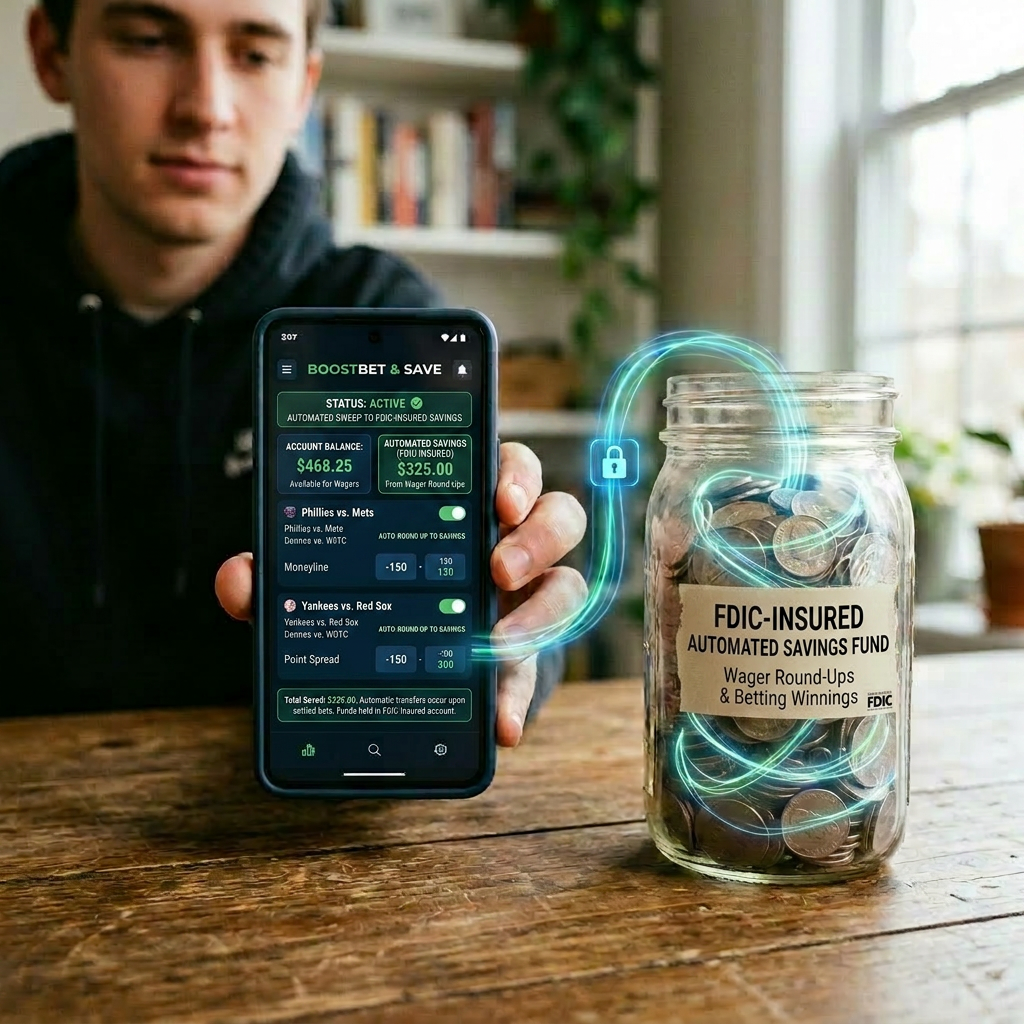
Regen (founded 2025; co-founders Daniel Prior and Benson Bleier) is an early-stage, betting-adjacent fintech — not a prediction or picks product. Its iOS app links a user’s sportsbook, daily-fantasy, and prediction-market accounts and automatically allocates a customizable percentage of every entry, win, or loss — pulled from a linked checking account into a separate, FDIC-insured savings wallet, with withdraw/pause control and a single P&L view across books. The pitch: ‘bet as usual, stack cash automatically, zero willpower required.’ This is a qualitative VC-style profile — no valuation, no rating — but it benefits from notably better disclosure than most early-stage names: named founders, a public team page, a founder blog, and a named institutional backer.
The thesis is genuinely differentiated and, unusually for this category, responsible-gaming-positive: rather than promising to beat the book (the credibility trap that sinks ‘verified ROI’ tools), Regen turns betting activity itself into an automatic savings habit — a familiar fintech primitive (round-up / auto-save) applied to wagering. The strongest external validation is real: in January 2026, GuardDog, Underdog’s responsible-gaming innovation fund, invested in Regen and struck a distribution partnership (featuring it in Underdog’s responsible-play hub, promoting it in customer comms, and giving all employees access). A named industry backer plus a built-in distribution channel is a materially stronger early signal than a marketing site alone — which is why this screens up to Strong / Engage, with the honest caveats being model durability and dependence on that single backer.
Profile — What Regen Is
What Would Have To Be True (the VC frame)
- ▸The savings behavior sticks: That users keep auto-saving across betting cycles rather than pausing/withdrawing when they want their stake back — the core retention question for a willpower-replacement product.
- ▸Unit economics work on a thin take: That Regen can monetize (interchange, float/interest, AUM on the roadmap products, or operator fees) enough on small per-bet sweeps to build a real business — classic fintech-margin question.
- ▸Underdog is a launchpad, not a ceiling: That the GuardDog/Underdog channel seeds growth without making Regen dependent on (or captured by) one operator — see the key risk below.
- ▸The roadmap lands: That the move from a savings wallet into ETFs / robo-advisor / Roth IRAs executes — this is where durable, higher-margin fintech value (and the ‘education by osmosis’ mission) actually accrues.
- ▸Regulatory posture stays clean: That linking betting accounts to a savings/brokerage product navigates money-transmission, banking-partner, and gaming-adjacent compliance — an execution requirement, not a red flag, but real.
Assessment Summary
Regen is the strongest of the early-stage names screened so far, by a clear margin. It pairs a genuinely original, RG-positive wedge with the things the weaker names lacked: named credible founders, a real institutional backer (GuardDog/Underdog), a distribution partnership, and — critically — no visible credibility red flag (it makes no profitability claim to contradict). Under the startup standard applied here, the unknowns (funding amount, user count, revenue, retention) are diligence items, not negatives. The honest VC read: differentiated thesis, real backing, clear diligence path — this warrants founder engagement, with the tough-marker focus on model durability and single-backer dependency, not on the (normal-for-stage) data gaps.
KCC Investment Screen
Scored against a KCC-style weighted fit-to-thesis model for early-stage betting-adjacent companies, using a startup-appropriate standard: missing or unverifiable data is treated as a diligence gap (lean Moderate), not a failure — early companies are thin by default, and penalizing them for being early just causes missed opportunities. Harsh ratings (Weak/Unfit) are reserved for affirmative, observable problems; Regen presents none. A backing / validation criterion is weighted in, because a named institutional backer with a distribution deal is precisely the kind of external signal that de-risks an early company. This is a screening output, not a valuation.
| Criterion (weight) | Fit | Rationale |
|---|---|---|
| Differentiation / product (20%) | ◕Strong | Original, RG-positive wedge: auto-savings tied to betting activity (not picks); a real fintech primitive applied to a new context |
| OSB / prediction-mkt fit (15%) | ◕Strong | Spans sportsbook, DFS & prediction markets natively; sits in the value chain as financial-wellbeing infrastructure on top of play |
| Backing / validation (15%) | ●Excellent | Named institutional backer: GuardDog (Underdog) investment + distribution partnership (RG hub, customer comms, employee access) |
| Market / TAM (10%) | ◑Moderate | Large betting population & real fintech adjacency, but ‘savings on betting’ is a new behavior of unproven size; roadmap (ETF/IRA) widens it |
| Moat / defensibility (15%) | ◑Moderate | Integrations + the Underdog relationship + brand are early moats; the core auto-save mechanic is replicable — durability is the open question, not a proven flaw |
| Team / founders (15%) | ◕Strong | Named, credible founders (Prior: consulting/VC; Bleier: ex-Accenture, pro poker); poker origin is thesis-coherent. Depth beyond two is a DD item |
| Traction / evidence (10%) | ◑Moderate | Diligence gap (no disclosed users/revenue/funding amount) — normal for stage; offset by a real backer & live iOS app. Resolve via founder data, do not penalize |
| Overall KCC fit | ◕Strong | On-thesis, real backing & distribution, credible founders, no visible red flag; gaps are diligence items. Clears the engage bar |
Action-Band Interpretation
- ▸Excellent ● — Act: high-conviction, defensible, validated, with confirmed traction/economics. Regen needs diligence data to reach this.
- ▸Strong ◐ — Engage: on-thesis, credibly backed, no red flag — warrants founder contact and diligence. Regen lands here.
- ▸Moderate ◕ — Monitor / DD: on-thesis but with material unknowns and no external validation yet — watch.
- ▸Weak ◔ / Unfit ○ — Pass (for now): a visible, affirmative problem — not merely missing data. Regen shows none.
KCC Verdict
ENGAGE (overall fit: Strong). Regen is the cleanest early-stage candidate screened to date: a genuinely differentiated, responsible-gaming-positive wedge; native coverage across sportsbook, DFS, and prediction markets; named, credible founders; and — the decisive external signal — a GuardDog (Underdog) investment and distribution partnership. Critically, there is no visible red flag: it makes no profitability claim to contradict, and its disclosure is above-average for stage. The right action is to engage the founders and run diligence — the open questions (model durability, unit economics, retention, and dependence on Underdog) are things to resolve, not reasons to pass. This is where capital diligence is genuinely warranted.
Competitive Landscape & Moat Analysis
Regen occupies an unusually empty competitive lane: it is a consumer-fintech savings mechanic pointed at betting activity, a space the big round-up savers (Acorns, Qapital) don’t touch and the betting tools (picks/edge apps) aren’t in. Its nearest neighbors are sibling RG tools and the operators’ own in-app controls — neither of which does what Regen does. The teardown maps the field and stress-tests the moat under the startup standard (durability questions, not absence-of-data).
| Player | What it is | Stage / backing | Read vs. Regen |
|---|---|---|---|
| Regen | Auto-savings on betting activity (fintech) | Pre-seed; GuardDog/Underdog | The subject; RG-positive, distribution-backed |
| Acorns / Qapital (round-up savers) | Consumer auto-save / round-up fintech | Scaled, funded | Proven mechanic; Regen applies it to a niche (betting) they ignore |
| idPair (GuardDog portfolio) | Cross-operator high-risk-activity reduction | GuardDog-backed | Sibling RG-tool, not a competitor; same ecosystem |
| Operator in-app RG tools | Deposit limits, cool-offs, dashboards | In-house at books | Compliance-driven, not savings; Regen is operator-agnostic |
| Picks/edge tools (SportBot, Parlay Savant) | AI predictions / research | Bootstrapped | Different category — they chase edge, Regen banks behavior |
| Sportsbooks / DFS (Underdog et al.) | The platforms Regen links to | Public/scaled | Partners & distribution — but also the dependency risk |
The Moat Stress-Test
- ▸vs. incumbent savers (Acorns/Qapital): They have scale and trust but ignore betting; Regen’s edge is the betting-native integration and framing. The risk: if the betting-savings behavior proves large, an incumbent could add it — so speed, brand, and operator relationships must compound first.
- ▸vs. operators building it in-house: The Underdog partnership shows operators want this — which cuts both ways. A book could build its own savings sweep; Regen’s operator-agnostic, cross-book position (and RG-credibility) is the defense.
- ▸The dependency question (the real one): GuardDog/Underdog is Regen’s biggest asset and its concentration risk. Heavy reliance on one backer-distributor for growth and credibility is a genuine strategic vulnerability — not a flaw to penalize today, but the central diligence question.
- ▸vs. general inertia: The hardest competitor is ‘users just don’t save.’ The willpower-free design addresses this, but whether auto-savings on betting becomes a real habit (vs. a quickly-paused novelty) is unproven and is the core durability test.
Where Regen Wins — And The Honest Caveat
Regen’s genuine strengths are real and specific: a differentiated, RG-positive wedge in an empty lane; cross-format reach (sportsbook, DFS, prediction markets); a named institutional backer with built-in distribution; and credible founders with a thesis-coherent origin story. The roadmap into ETFs/robo/Roth IRAs is where durable fintech margin and the ‘financial-wellbeing’ mission could actually compound. The honest tough-marker caveats — held as diligence questions, not disqualifiers — are two: (1) durability, whether ‘savings tied to betting volume’ is a lasting product or a clever feature an incumbent absorbs; and (2) dependency, the concentration on Underdog/GuardDog for growth, credibility, and distribution. Neither is visible today as a problem; both are exactly what capital diligence exists to resolve. That combination — real differentiation, real backing, no red flag, clear questions to answer — is what makes this an engage, not a watch.
What Is — And Isn’t — Knowable
Regen’s disclosure is above-average for an early-stage company: named founders, a public team page, a founder blog, named institutional backing, and clear model mechanics. The unknowns that remain — funding amount, users, revenue, retention, unit economics — are the normal-for-stage gaps a private pre-seed company doesn’t publish. Per the startup standard applied here, these sit in the right-hand column as diligence items to resolve, not strikes against. There is no self-contradiction or visible red flag to weigh.
| Reasonably established | Diligence items (not negatives) |
|---|---|
| Founded 2025; co-founders Prior & Bleier | Funding amount / valuation (GuardDog terms undisclosed) |
| iOS app live; Android coming; Discord | User count, MRR, revenue model specifics |
| Model: auto-sweep % of bets to FDIC wallet | Retention / how often users pause or withdraw |
| GuardDog (Underdog) investment + distribution | Unit economics / take rate / monetization |
| Links sportsbook, DFS & prediction markets | Team depth beyond the two founders |
| Roadmap: ETFs, robo-advisor, Roth IRAs | Regulatory/banking-partner structure detail |
Strengths, Open Questions & Outlook
- –Differentiated, RG-positive savings wedge
- –Named backer + distribution (GuardDog/Underdog)
- –Cross-format: sportsbook, DFS, prediction mkts
- –Credible founders; thesis-coherent origin
- –Roadmap to ETFs / robo / Roth IRA (durable margin)
- –No visible credibility red flag
- –Model durability vs. an incumbent absorbing it
- –Underdog dependency / concentration risk
- –Retention: does auto-save habit stick?
- –Unit economics on thin per-bet sweeps
- –Regulatory / banking-partner structure
- –Team depth beyond two founders
Outlook & Recommended KCC Action
- ▸Base path: A differentiated RG-positive savings app that grows via the Underdog channel and word-of-mouth, proving out the auto-save habit on betting before layering in higher-margin wealth products.
- ▸Upside path: The savings habit sticks, the roadmap (ETF/robo/Roth IRA) executes, and Regen becomes a financial-wellbeing layer across betting/DFS/prediction markets — an acquisition target for operators or a standalone fintech.
- ▸Downside path: The behavior proves a novelty users pause; an incumbent saver or operator absorbs the mechanic; or over-dependence on Underdog caps independent growth.
- ▸Recommended action: Engage. Founder outreach + diligence are warranted now. Request the standard data room (funding/round terms, users, retention, unit economics, regulatory structure, team) and pressure-test durability and Underdog dependency — the two questions that decide the investment, neither of which is a reason to pass today.
Bottom line: Regen is the strongest early-stage name screened to date — a Strong ◕ / Engage under the startup standard. It pairs a genuinely original, responsible-gaming-positive wedge with the validation the weaker names lacked: credible named founders, a real institutional backer, and a built-in distribution partnership — and, importantly, no visible red flag. The honest tough-marker caveats are real but are diligence questions, not disqualifiers: whether the savings-on-betting model is durable, and how dependent Regen is on Underdog. Those are exactly what a diligence process exists to answer — which is why the call is to engage, not to watch from a distance.
IMPORTANT DISCLOSURES. This is a qualitative early-stage / VC-style profile and internal screening document prepared for analytical purposes. Regen is privately held and does not disclose financials; this document deliberately contains no valuation, revenue/EBITDA figures, or public-equity rating. The KCC fit assessment is a screening heuristic, not a valuation or recommendation. Observations reflect the author’s good-faith reading of the company’s public site, founder interviews, and partner (Underdog/GuardDog) announcements as of the date below; readers should verify directly. It is not investment advice, and the subject sits in a category overlapping the author’s professional domain — treat accordingly.
DATA & SOURCES. Information derives from Regen’s website, founder interviews (incl. The BettingStartups Podcast), and Underdog/GuardDog press: founded 2025; co-founders Daniel Prior (consulting/VC) and Benson Bleier (ex-Accenture, former professional poker player), who met in Argentina; iOS app live (Android forthcoming); Discord community; campus-ambassador program. Model: links sportsbook, daily-fantasy, and prediction-market accounts and automatically sweeps a customizable percentage of each entry, win, or loss from a linked checking account into a separate, FDIC-insured savings wallet, with withdraw/pause control and a single cross-book P&L view. In January 2026, GuardDog — Underdog’s responsible-gaming innovation fund — announced an investment in Regen plus a distribution partnership (featuring Regen in Underdog’s responsible-play hub, promoting it in customer communications, and providing access to all employees). Stated roadmap includes ETFs, robo-advisor funds, and Roth IRAs. Funding amount, valuation, user count, revenue, and retention are undisclosed. Details may be incomplete, dated, or change after publication.
FORWARD-LOOKING & QUALITATIVE STATEMENTS reflect strategic interpretation, not forecasts, and are subject to model-durability risk, single-backer (Underdog) dependency, retention/behavioral risk, unit-economics uncertainty, regulatory and banking-partner requirements, and competition. The GuardDog/Underdog investment is publicly announced; its financial terms are not disclosed. No further transaction, fundraise, or acquisition is known, rumored, or implied. Independently verify all details before any decision.


Leave a comment